



Taxes On the Import of Gold Into Switzerland
Additional information > Prevailing conditions for value storage in Switzerland and Liechtenstein > Taxes On the Import of Gold Into Switzerland
Note: This article makes no claim to be comprehensive and it does not constitute any explicit legal advice. As such, it is for guidance only. For legally binding information, we recommend that you contact a lawyer of your choice and the information that is available from the regional customs offices as well as the Swiss Federal Customs Administration or the Swiss Federal Department of Finance.
Import Tax for Gold From Abroad. Exemptions from Sales Tax
Investors from Europe who want to transfer their gold investment or other assets to Switzerland – and store them there – must pay the necessary taxation that is applicable in the country concerned upon import. The so-called import tax is based on the same principles as the statutory value added tax, which must be paid on the net price of most goods. Although the purchase of gold in the home country remains largely free from such sales tax, this no longer applies when it crosses an international border. Fortunately, there are extensive exemptions from Swiss sales tax on investments that are made in gold.
The regulations of value added tax (VAT) are maintained by the respective sales tax laws of individual countries. Such taxation was introduced in Switzerland for all goods in 1995. According to Article 107 of the VAT Act, however, the Federal Council may issue different provisions. For example, the Sales Tax Ordinance has made wide-ranging exemptions from the sales tax requirements that would otherwise affect the purchase of gold for investment.
© vladk213 - stock.adobe.com
Swiss Sales Tax Regulations Contain Exceptions
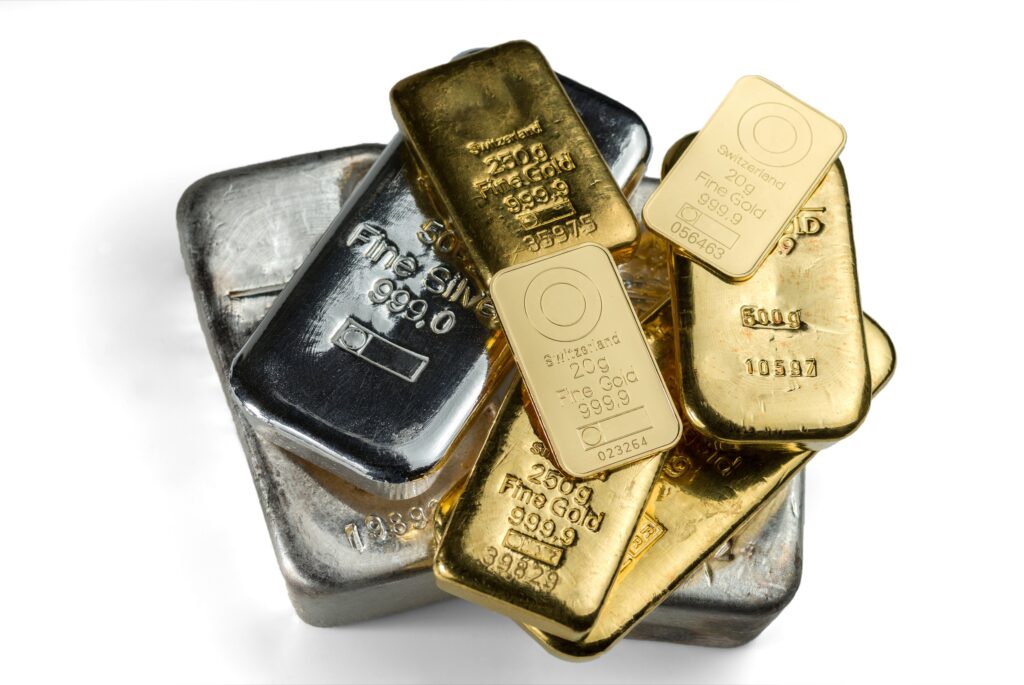
The exceptions allowed under Value Added Tax Ordinance (MWSTV) are to be found summarised under Article 44. Accordingly, the sales of state-stamped gold coins with fine values of tariff numbers 7118.9010 and 9705.0000 are exempt from tax (for the definition, see the relevant chapter). This also applies to gold which is acquired for investment purposes so long as it has a minimum purity of 995/1000. In addition, cast or punched gold bullion bars must have a purity rating as well as the stamp of a recognised assayer-melter (see the relevant chapter).
In addition, gold in the form of granules (gold dust) is also exempt from this tax, provided it has a purity of 995/1000. It must then be weighed, packaged and sealed by a recognised assayer-melter. The article also regulates other forms, such as raw gold or primary materials, as well as so-called semi-finished products which are intended for industrial production but which are, therefore, less relevant for private investors. This also includes alloys that consist of two or more parts of gold. If platinum is contained, then the proportion of gold must outweigh that of the platinum for these rules to apply.
The Sales Tax Act and Ordinance are supplemented by Directive R-69-02 for tax exemptions on imports. It contains implementing provisions for the Federal Office for Customs and Border Security and aims to ensure uniform application of the sales tax provisions in them.
What Do Customs Tariff Numbers 7118.9010 and 9705.0000 Mean?
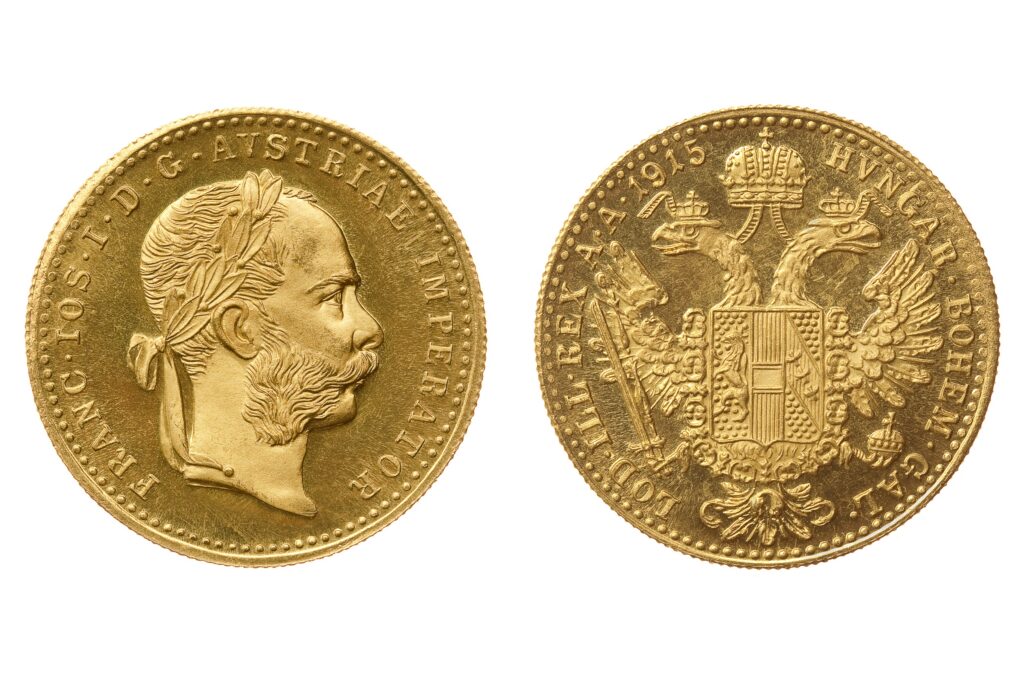
Article 44 of the Sales Tax Act contains tariff numbers which are intended to clearly outline the definition of gold coins. For example, tariff number 7118.9010 simply says that the products concerned are to be considered gold coins. Customs tariff number 9705.0000 stands for: ‘Collections or collectables (…) of (…) numismatic value’. This exemplification has often led to confusion in the past. This is largely down to the fact that Article 44 does not provide an official definition of the term ‘state-certified’. Among other things, there has been a legal dispute over the status of the Austrian gold ducat in the past, for example.
Read the Federal Court’s Judgement 2C 159/2019 as of July 23rd, 2019.
At this time, the Federal Customs Administration included the following statement by the Federal Court as a part of its guidelines:
‘State-minted gold coins, as defined in the sense of Art. 44 Para. 1 lit. of the Sales Tax Ordinance, should be understood to mean a piece of gold that is guaranteed by the issuing state in terms of its weight and content. It must be, or intended to be, used for the payment of transactions and not considered to be coins, in the above sense, that have been reissued.’
Accordingly, only the historical ducats minted in the years from 1872 to 1915 are considered to be state-certified and, in any case, these are now traded more as collector’s items. This does not apply, however, to the newly embossed ducats that have been available since 1961 and were produced by the Austrian Mint for the investment market in the same vintage as the 1915 variety. It is worth knowing that the Vienna Mint also minted legal tender at this time and was active in state services then as now.
© vladk213 - stock.adobe.com
Why Do Gold Bars and Granules Need Recognised Stamps?
In order for gold bars to be recognised as exempt from sales tax, they need the stamp of a recognised assayer-melter. The Federal Customs Administration specifies this in its document: ‘Regulations on melting and testing precious metals’.
Determinations of the fineness of melted products made abroad are only recognised in Switzerland if they come from a recognised assayer-melter. The corresponding lists can be viewed on the internet:
LBMA good delivery list
LPPM good delivery list
This means that gold bars that are on the London Bullion Market Association’s (LBMA) official and constantly updated Good Delivery List are considered to be exempt from import tax.
A judgement of the Federal Court of November 1st, 2013 demonstrates the meaning of the stamp marks of the recognised assayer-melter. The subject of the court proceeding involved the import of gold bars into Switzerland by a Chinese citizen. Although these bars bore the required fineness data, they did not have the obligatory stamps. Since the traveller had used the green passage with ‘nothing to be declared’ to enter the country and the precious metal was subject to import tax due to their lack of a stamp, the gold bars were confiscated during a customs check. The Federal Supreme Court confirmed this procedure in its judgement 2C 518/2013.
Are older bars without a current manufacturer's certificate still duty-free?
Older bars originating from former LBMA-certified manufacturers, who no longer have a current certificate, are also exempt from import duties. What is important here is that the bars in question were manufactured at a time when the LBMA certification was still valid. Where any doubt exists, the importer is obliged to prove that the manufacturer was certified at the time of production. In certain situations, this might be difficult to prove, because standard bullion bars do not usually have a production date or a stamped year of manufacture. However, this information can often be found in an accompanying certificate.
Good Delivery bars in denominations of 1000 ounces of silver, or 400 ounces of gold, are much easier to organise, because the LBMA stipulates that the marking information on the surface must include the year of manufacture. However, this same requirement does not apply to bars with other product weights.
The LBMA’s current list shows which manufacturers are exempt from import tax. This is also stipulated in the Federal Office for Customs and Border Security (BAZG) Directive R-69-02 on tax exemptions, section 21.3. Gold bars that come from a manufacturer who was previously LBMA-certified, but who is not currently on the LBMA list, are thus not automatically tax-exempt. In such circumstances, the bars would generally be taxed in the first instance until the necessary evidence became available.
- Tip: When importing older bars – and before crossing the border – investors should have available, and carry with them, all necessary evidence to prove the goods were manufactured in a certified manner. Alternatively, investors should only import new bars originating from a current LBMA-certified source.
Buy gold ex-VAT
Investors who wish to store their bullion gold in Switzerland have the option to buy gold coins or gold bars direct from a specialist dealer in Switzerland. And as previously mentioned, gold purchased in this way for investment purposes remains exempt from VAT. This advantage allows the amount of capital you have available for investment to be fully utilized.
Instead of being exported to your home country, your precious metal holding can remain in Switzerland securely stored in a safe deposit box, or under segregated custody arrangements – at Swiss Gold Safe, for example. This method avoids all the worry and inconvenience of import arrangements, and also means you retain the advantage of buying investment gold without paying VAT. More details about what kind of investment gold is suitable for this purpose, and further useful information, can be found in our article: Purchasing gold as a form of investment.
The Most Important Points in Summary:
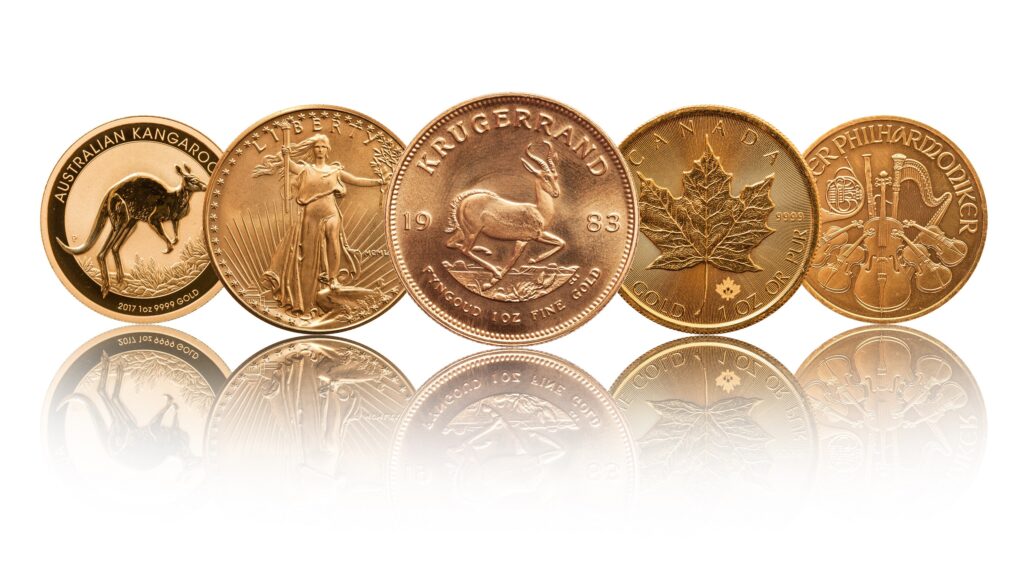
Gold bars in either a cast or stamped form are free from sales tax, provided they have a stamp confirming a purity of at least 995/1000. They must also be marked with the maker’s stamp. The following list contains well-known bullion coins that remain tax-free in Switzerland:
| Name of the Gold Coin | Fineness | Place Where it Was Minted |
| American Eagle | 916.7/1000 | USA |
| Birds of Paradise | 999.9/1000 | Australia |
| Britannia | 999.9/1000 | UK |
| China Panda | 999.0/1000 | China |
| Goldvreneli | 900.0/1000 | Switzerland |
| Helvetia | 900.0/1000 | Switzerland |
| Krügerrand | 916.7/1000 | South Africa |
| Lunar Serie | 999.9/1000 | Australia |
| Maple Leaf | 999.9/1000 | Canada |
| Nugget Känguru | 999.9/1000 | Australia |
| Wiener Philharmoniker | 999.9/1000 | Austria |
© Matt Light - stock.adobe.com
In contrast to countries of the European Union (EU), the following coins are not tax-free in Switzerland because they are reissued replicas of the historic originals:
- Austria: One ducat restrike mint (dating from 1915 and the erroneous issue of 1951)
- Austria: Four ducat restrike mint (dating from 1915 and the erroneous issue of 1951)
- Austria: 10 kroner restrike mint (dating from 1912)
- Austria: 20 kroner restrike mint (dating from 1915)
- Austria: 100 kroner restrike mint (dating from 1915)