
Table of contents

Gold and its prevalence

Gold is a metal, or more precisely a precious metal, and is also one of the elements chemistry describes as a “coinage metal”. The average proportion of this yellow precious metal found in the earth’s crust is four grams per 1,000 tons of rock [1]. However, gold is not only present on land, small concentrations can also be traced in seawater. Conservative estimates suggest the world’s oceans contain some 45,000 tons of dissolved gold [2].

According to the most realistic estimates, around 208,500 tons of gold have been mined over the course of human history. Two thirds of this total has been extracted since 1950 [3]. And because gold is almost indestructible, pretty much all the gold ever mined should still be available in one form or another – a feature which explains gold’s very high stock-to-flow ratio. Unlike other commodities such as oil or wheat, there is always a huge imbalance between the annual production of gold and the total inventory available. Gold production is currently around 3,500 tons per year, which yields an approximate stock-to-flow ratio of around 60 (stock/flow: 208,500/3,500). In concrete terms, this means it would take about 60 years for gold production at the current rate to double the current gold stock.

Main gold-producing countries

A little over 40 percent of the gold mined globally comes from China, Australia, Russia, Canada and the United States of America [4]. The deepest gold mines in the world can be found in South Africa, another of the larger international gold producers. South African shafts for mining gold extend almost 4,000 metres down into the earth. [5].

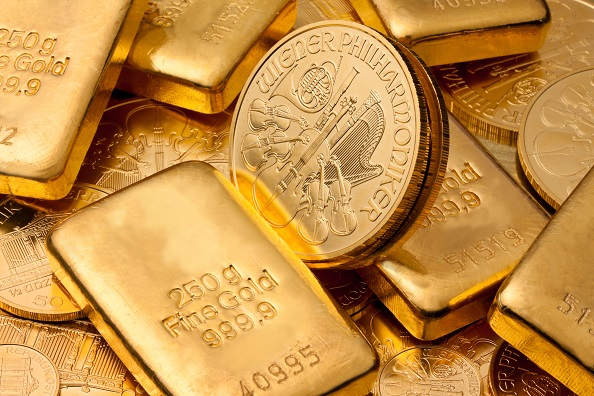
A variety of 250g gold bars and Vienna Philharmonic gold coins
Gold coins and gold bars are popular with investors.
© Erwin Wodicka - stock.adobe.com

Gold refineries and their products

While gold mining is spread across the countries mentioned, Switzerland is home to five of the eleven largest European gold refineries. These include: Argor Heraeus in Mendrisio, Valcambi in Balerna and Pamp in Castel San Pietro, all based in the southern canton of Ticino near the Italian border.

You can find more detailed information in our article on precious metal refineries

Most gold is usually cast or minted in bars of various sizes or coins of various denominations. Gold bars also include Coin Bars and CombiBars.

The Most Important Gold Coins

There are many different gold coins. Some of the most important ones are described briefly below.

Gold coin Country Fineness First minted Weights options in troy ounces Trivia
US
916,7
1986
1, 1/2, 1/4, 1/10 oz
AU
999,9
1986
10, 2, 1, 1/2, 1/4, 1/10, 1/20 oz and 1 kg
The world’s largest coin is the Australian Kangaroo produced in 2011 with a weight of around 1 tonne.
Aus. Koala
AU
999,9
2007
2, 1, 1/2, 1/4, 1/10, 1/25 oz
GB
999,9 (bis 2012 917,0)
1987
5, 1, 1/2, 1/4, 1/10, 1/20 oz
CN
999,0
1982
1, 1/2, 1/4, 1/10, 1/20 oz and 1g, 3g, 8g, 15g, 30g
CH
900,0
1897
2,903 g, 5,807 g ,
29,032 g
Helvetia
CH
900,0
1883
5,807 g
ZA
916,6
1967
50, 5, 1, 1/2, 1/4, 1/10, 1/20, 1/50 oz
MX
999,0
1981
1981 1, 1/2, 1/4, 1/10, 1/20 oz
AU
999,9
1996
10, 2, 1, 1/2, 1/4, 1/10, 1/20 oz and 10, 1 kg
CA
999,9 (bis 1981 999,0)
1979
1, 1/2, 1/4, 1/10, 1/15, 1/20 oz
5 pieces of the 100 kg Big Maple Leaf were produced in 2007. One of them was later stolen from the Bodemuseum in Germany.
UK
916,7
1817
36,61 g, 14,64 g, 7,322381 g, 3,661 g
Wiener Philharmoniker
AT
999,9
1989
1, 1/2, 1/4, 1/10,
1/25 oz
The Big Phil is a 1000 oz (31.103 kg) version of the Philharmonic produced in 2004.

Krugerrand: the first bullion coin

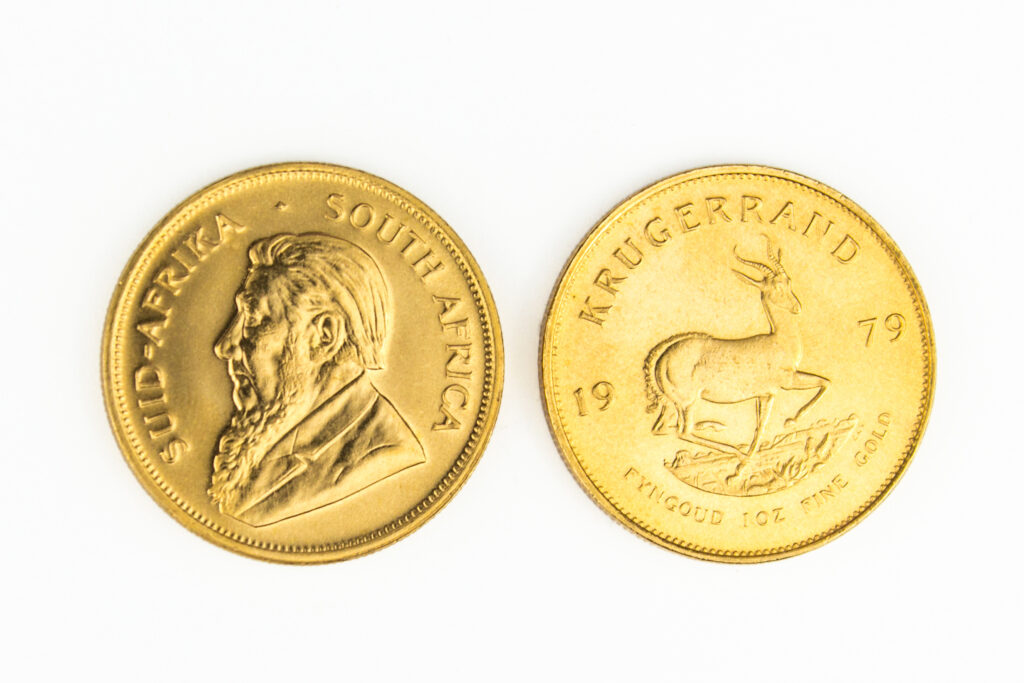
This gold coin is probably one of the oldest bullion coins and has been minted by the South African Mint in Pretoria since 1967. The front face depicts an African springbok as a symbol of the Kruger National Park, while the obverse displays a likeness of Paul Kruger, a former South African President. Unlike most other gold bullion coins, the Krugerrand is made of 916-gold. The addition of copper gives these coins a reddish tinge and makes the coin surface harder and more durable than pure gold coins.

Image of the front and back of a Krugerrand
The Krugerrand is one of the most common gold coins.
© hanohiki - stock.adobe.com

Maple Leaf: a Canadian classic

This precious metal coin comes from Canada and is the next best-selling bullion coin after the South African Krugerrand. This gold coin was first issued in 1979 and takes its name from the Canadian Sugar Maple. Due to its high fineness of 999.9 thousandths of gold, the surface of the Maple Leaf is soft and not very resistant to mechanical stress. This means it is best regarded as an investment coin rather than for use as a means of payment.

Vienna Philharmonic: a sonorous metal coin from the Austrian Mint

As its name suggests, this bullion coin comes from Austria. It was first minted in 1989. The front of the coin has images of some instruments from the Vienna Philharmonic orchestra – cello, viola, violin, horn, bassoon and harp – while the back displays the legendary organ from the famous Wiener Musikverein concert hall. With a gold content of 999.9, the Vienna Philharmonic is a gold coin of very high quality created from the purest fine gold.

Britannia: investment gold from the United Kingdom

The female goddess Britannia, representing England, has adorned this gold coin since 1987, with the head of state appearing on the obverse side. A one-ounce coin has a purity of 999.9, and the Britannia is considered to be the first bullion coin in Europe with a modern design. It is issued by the Royal Mint, a British mint whose origins date back to 886.

Chinese Panda: a gram coin from the Far East

The Chinese Panda bullion coin has been minted since 1982 on behalf of the Chinese government. Its name references the iconic Chinese panda bear, threatened with extinction, which is depicted on the front using a design that changes every year. This coin has a fineness of 999/1000. However, it should also be mentioned that, in 2016, the weight of the coin was changed from the traditional troy ounce (31.103 grams) to a “more-rounded” unit weighing precisely 30.00 grams.

Kangaroo Nugget: a popular Australian bullion coin

Until 1989, the obverse of this bullion coin showed a gold nugget, but today the coin displays an Australian kangaroo using images that change every year. This change is said to have been implemented simply because a bullion coin with an animal motif is easier to market. The reverse side of the coin features Queen Elizabeth II or King Charles III respectively as head of the Commonwealth of Nations. This Australian gold coin has a fineness of 999.9/1000.

American Eagle: a coin from the United States

The USA, or rather the US Mint, has been minting the American Eagle gold coin since 1986. The bald eagle was chosen for the front image because it is used as a heraldic symbol of the United States of America. This coin has a fineness is 916.67 percent gold, with an alloy of copper and silver making up the remaining portion. The reverse of this bullion coin carries an image of Libertas, the Roman goddess of liberty.

As already mentioned, only the most significant gold coins are listed here and there are many others. All bullion coins have their own particular characteristics, and which coin investors choose may often depend on personal preferences. However, generally speaking, the most common bullion coins can be more easily sold on later simply because they are traded and accepted worldwide.

Storage facilities for gold

There are various options for storing gold in physical form: Small amounts can be deposited at home in a good hiding place, or in kept in a home safe. In addition, safe deposit boxes are a secure alternative for larger amounts of gold. However, if you value independence, discretion and the greatest possible privacy, you should consider storage using safe deposit boxes that are independent of banks and dealers.

Bank-independent safe deposit boxes are offered by the private storage company Swiss Gold Safe, for example, where clients from all over the world can choose between safe deposit boxes located in Switzerland or a safe deposit box located in the Principality of Liechtenstein. They are suitable for gold bars, gold coins and/or gold granules. All safe deposit boxes are located within high-security facilities, available in different sizes, and include basic insurance.

Both countries are non-EU states with high standards of general safety and a well-functioning infrastructure. They are internationally renowned and valued for their uncompromising preservation of personal property rights. Furthermore, Switzerland and Liechtenstein also offer a high level of economic and political stability, and both are centrally located in the heart of Europe.

Swiss Gold Safe also offers allocated and segregated custody, also known as individual custody or special custody. Under this arrangement, all gold stocks with bar or seal numbers are stored on segregated pallets, or in special safe deposit boxes, in the name of each client.

No bank account is required to arrange a storage contract, and the fees can be paid in cash or via cryptocurrencies. And there is another important feature storage specialists can provide: Unlike all banking systems, Swiss Gold Safe is not obliged to automatically release customer data to the regulatory authorities.

The primary characteristics of gold

The advantages of gold in broad terms include its almost indestructible nature as well as its high value density, a feature which makes it possible to store large-value quantities in a small space. At the same time, gold also represents a universal currency that is accepted globally. These features make this yellow precious metal extremely liquid, which is also reflected in the fact that gold has a very small spread: In other words, the purchase and sale prices of gold are very close together.

Some of gold’s disadvantages include the high transportation fees. In addition, gold as an investment is repeatedly criticised for the fact that, unlike other assets, it does not yield interest gains. While share dividends accumulate and bonds pay interest, gold investors can usually only make a profit via currency price changes – i.e. by selling your precious metal at a higher gold price than you originally paid.

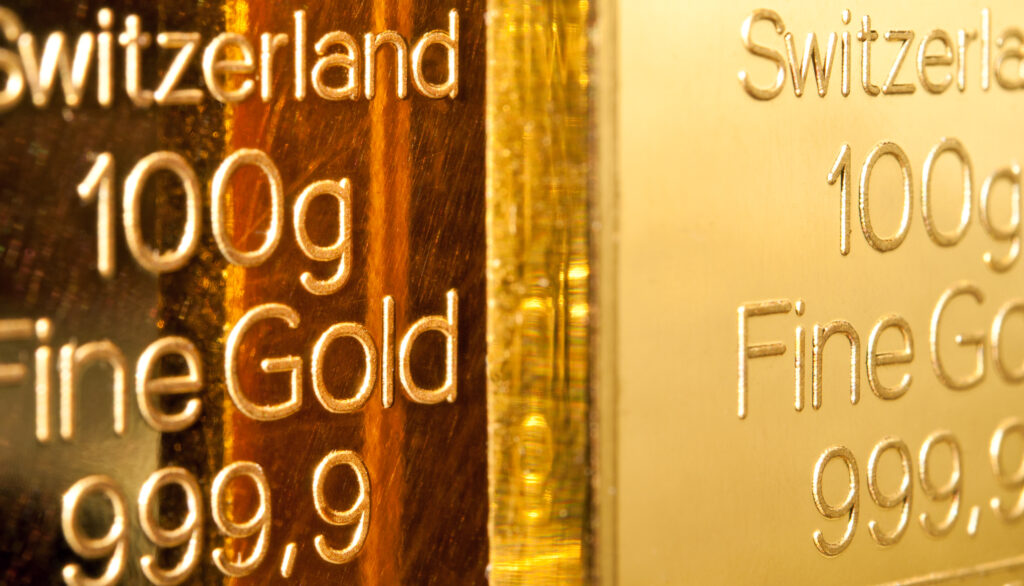
Close up of two 100g gold bars from Switzerland
Close ups of Swiss gold bars
© Ded Pixto - stock.adobe.com

Gold: Interesting facts and trivia

Classic facts about gold

The price of gold is negotiated via international exchanges on a daily basis and is initially quoted in US dollars. Its price is largely based on supply and demand. A conversion then takes place for each respective national currency at the current exchange rate. This results in different pricings.

Gold fixing is used to determine the price of gold. It is conducted twice a day by the London Bullion Market Association (LBMA). Its representatives set a fixed price for one ounce of gold.

According to the World Gold Council (WGC), around 3,500 tons of gold are mined each year. By the end of 2022, the total amount of raw gold that has ever been mined on Earth will be around 208,500 tons.

To illustrate this, the WGC designed an imaginary cube. Each edge of this cube is currently 21.99 metres long. That corresponds to 10,633 cubic metres of gold.

Depending on its design, a one-kilo bar has dimensions of 90 x 40 x 20 mm (L x W x H). This makes it even smaller than a typical packet of cigarettes. So it takes up very little space.

Depending on the current gold price, a 1,000-gram gold bar would cost between CHF 50,000 and CHF 55,000. This is equivalent to the price of a mid-range car.

Gold deposits and mining

Natural gold deposits in large quantities are found in Indonesia, South Africa, Papua New Guinea, Asia, China, The Dominican Republic, Australia, West Africa, Canada and Russia. The world’s largest gold mines are also found in these locations. Australia, Russia and South Africa are the countries with the most gold reserves.

Experts assume that an estimated 80 percent of the world’s gold deposits still lie in the earth’s crust. There are around four grams of gold in 1,000 tons of rock. Furthermore, due to rock erosion, it is also assumed that around 15,000 tons of gold particles are floating in our oceans.

Here are the top 10 global gold producing countries (tons per year):

  1. China (370 t)
  2. Australia (330 t)
  3. Russia (300 t)
  4. USA (180 t)
  5. Canada (170 t)
  6. Ghana (130 t)
  7. Mexico (100 t)
  8. South Africa (100 t)
  9. Uzbekistan (100 t)
  10. Indonesia (90 t)

With an estimated annual output of 115 tons, the Nevada Gold Complex in the USA is the most profitable gold mine in the world.

South Africa’s Mponeng mine, which began operations in 1986, is located at a depth of over 4,000 metres. The elevator ride from the surface to the bottom of the shaft takes over an hour.

Gold mining uses chemicals such as lead, borax, acid, lime and cyanide. Its complex processes are time-consuming and considered harmful to the environment. For example, gold processing usually consumes large amounts of electricity, which is why modern facilities such as the Nevada gold mine now operate by generating their own solar energy.

Five of the world’s largest gold processing refineries are located in Switzerland, which handles up to 70 percent of the global demand. There are other refineries in the USA, Australia, Japan, Great Britain, Germany and Austria.

Fairtrade Gold is a certified precious metal that is mined in an ecologically and socially responsible manner. The resultant products are then marked with the Fairtrade seal.

Because gold is virtually imperishable, it can always be melted down and processed into new products.

Around 540,000 large gold bars (8,133t) are stored in the underground vault of the Federal Reserve Bank in New York. That equates to about 25 percent of the world’s gold reserves in the hands of central banks. They are followed by the central banks of Germany (3,355 t), International Monetary Fund (IMF, 2,814 t), Italy (2,451 t), France (2,436 t), Russia (2,298 t), China (1,948 t), Switzerland (1,040 t), Japan (846 t) and India (768 t).*

* World Gold Council (WGC) H1 2022

Gold history

Scientists believe gold was formed by supernova nucleosynthesis and from the collision of neutron stars. When the earth was first created, molten iron formed at its core. Precious metals were then drawn towards the core, which is why they can be found in the earth’s crust.

The origin of gold coins dates back to 650 BC. It is said the Lydian king Croesus had the first coins made.

In 1869, Australians John Deason and Richard Oates discovered the largest gold nugget ever found, measuring 25.4 x 63.5 centimetres. Known as the “Welcome Stranger”, this nugget contained 2,248 ounces (almost 64 kg) of pure gold and was found just below the ground.

Until 1937, both Austria and The Netherlands still used gold coins as a means of payment. The start of World War II in 1939 marked the end of gold currencies.

Gold data

  1. Red Kangaroo: 1,000 kg, diameter 80 cm
  2. Maple Leaf: 100kg, diameter 53 cm
  3. Big Phil: 31.103 kg, diameter 37 cm
  1. Classic Gold Bar, Japan: 250 kg
  2. Cuboid Gold Bar, Japan: 120 kg
  3. Flat Gold Bar, China: 100 kg

Athletes were still awarded medals made from pure gold at the 1912 Olympic Games. Today, these trophies have a silver core which is then plated with about seven grams of pure gold.

The gold standard denotes a currency comprising physical gold coins or banknotes whose ultimate value is directly linked with gold.

The Latin Monetary Union (LMU) existed from 1865 to 1926. This alliance between Switzerland, France, Belgium and Italy aimed to standardize the different currencies used by each of these countries.

The London Bullion Market Association (LBMA) coordinates gold trading on the world’s largest over-the-counter market for physical precious metals. Trading rules allow only LBMA-certified gold bars originating from LBMA-approved manufacturers. The LBMA also defines the standards for Good Delivery bars.

Former US President Franklin D. Roosevelt signed Executive Order 6102 in 1933, which prohibited US citizens from hoarding gold, with exceptions for jewellers, electricians and dentists. Possession of gold was punishable by a $10,000 fine or ten years in prison. This limitation was not repealed until 1974.

Gold as an investment product

Coins or bars with a high gold content of at least 90 percent are used for investment purposes. This is often termed bullion gold.

When buying gold coins and gold bars produced for the investment market, no VAT is applied to the purchase. However, other gold products such as jewellery are not VAT exempt.

The weight of gold coins and many gold bars is generally expressed in ounces. One ounce corresponds to 31.103 grams. The main coin unit is 1 ounce, but 1/4, 1/2, 2 or 5 ounces are also common.

The fineness (also fine value or fine weight) is the proportion of precious metal a coin or bar contains. It is usually expressed using four digits to represent parts per 1,000.

The carat specification is used as a measure of the gold alloys used in jewellery. A 24-carat rating is equivalent to pure gold.

Bullion coins are mainly “uncirculated” coins straight from the mint. “Proof” coins is a common descriptor used for collector and/or commemorative coins.

Other investment products related to gold are: Gold securities such as ETFs, ETCs or ETNs, as well as gold mining stocks and gold futures contracts.

The gold-silver ratio is the relationship between the price of gold and silver. This index indicates how many ounces of silver are equivalent to one ounce of gold.

How is gold used?

Usage/Proportion*
Jewellery
rings, chains, bracelets, earrings, bezels
2,221 tons
Coins, bars, granules (also ETFs)
for investors and collectors
1,007 tons
Central banks
currency reserves, capital protection
463 tons
Industry and technology
electrical engineering, printed circuit boards, connectors
330 tons
Medicine and dental technology
dental implants, various medicines and ointments, biochemistry and nanotechnology
small amount
Gold leaf
for decorating objects such as furniture and picture frames.
small amount

* World Gold Council (WGC-World official gold holdings 2021)

Properties of gold

Gold is one of the elements. This durable metal is impervious to water, air or acids and never loses its lustre. It is a good conductor of heat and electricity and is extremely malleable.

  • Symbol: Au (from the Latin ‘aurum’)
  • Atomic number: 79

19.32 grams per cubic centimetre

1,064.18 degrees Celsius (1,337.33 K)

  • Conductivity: 45.5*106 Siemens per metre
  • Resistance: 0.0220*106 micro-ohms per metre

320 watts per metre/Kelvin

[1] David R. Lide (Hrsg.): CRC Handbook of Chemistry and Physics. 90. Auflage. (Internet-Version: 2010), CRC Press/Taylor and Francis, Boca Raton, FL, Geophysics, Astronomy, and Acoustics; Abundance of Elements in the Earth’s Crust and in the Sea, S. 14-18.

[2] https://www.thoughtco.com/how-much-gold-is-in-the-ocean-4165904

[3] https://www.gold.org/about-gold/gold-supply/gold-mining/how-much-gold

[4] United States Geological Survey: World Mine Production and Reserves January 2017

[5] https://www.goldreporter.de/goldsuche-extrem-sudafrikaner-wollen-auf-5-000-meter-runter/gold/6101/

[6] https://www.20min.ch/finance/news/story/Schweiz-gehoert-zu-den-groessten-Goldverarbeitern-29921503

Share by E-Mail
Share by WhatsApp
Share by Facebook
Share by Telegram
Share by X
Share by LinkedIn
Print